
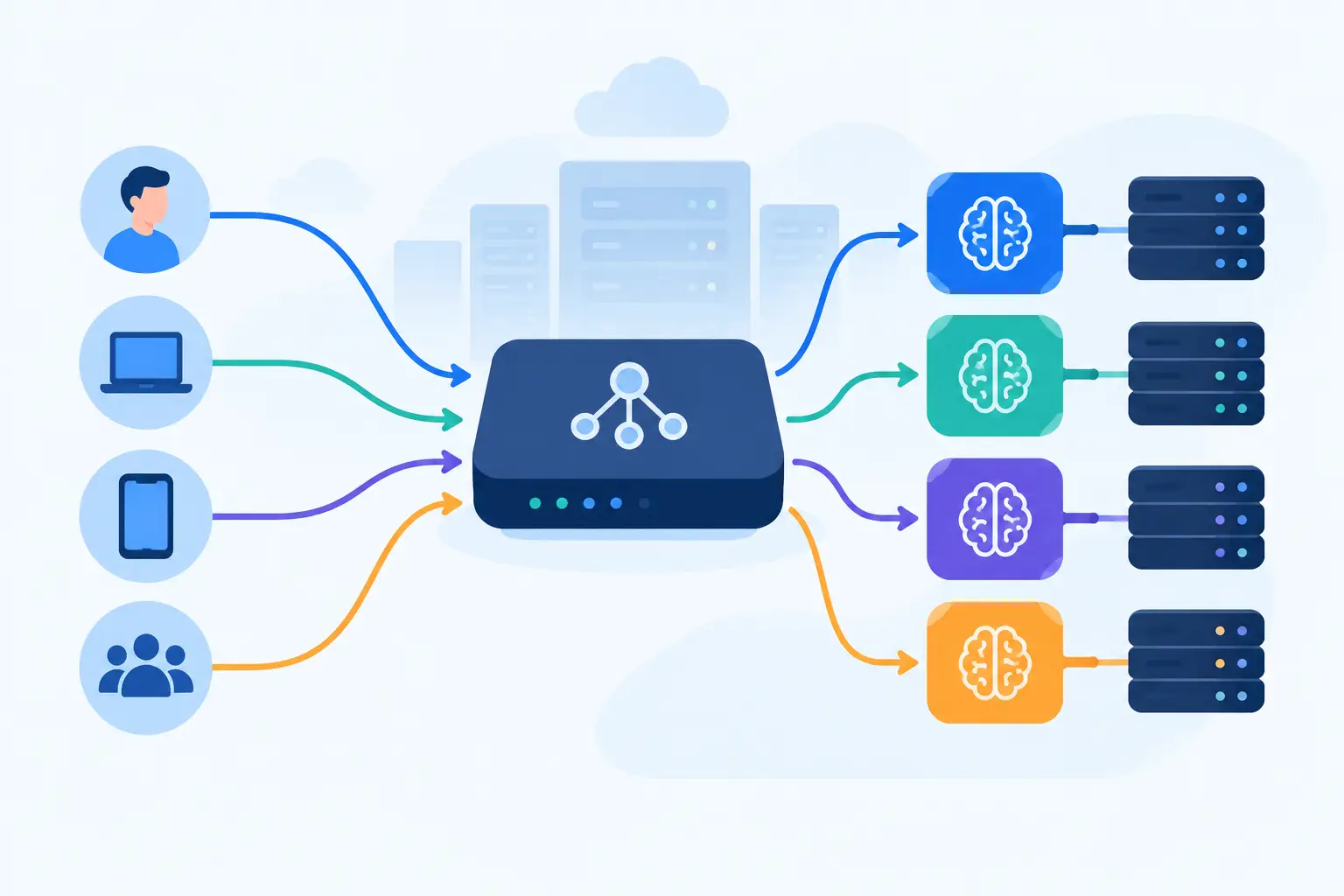
An enterprise model router review should not start with a provider comparison chart. It should start with a production request: a customer prompt containing sensitive information, sent during a provider incident, through an application that must stay within budget. The useful question is whether the routing layer makes the right model decision while enforcing the same controls every team expects.
For engineering leaders, that changes the evaluation completely. A router is not merely a way to reach more models. It becomes the control point between applications and providers, where availability, cost, data handling and policy enforcement meet. If it cannot be assessed under realistic traffic and failure conditions, a polished dashboard is beside the point.
What an enterprise model router review should establish
A production router has to prove three things. First, it must select an appropriate capable model according to defined routing rules, priorities and logical routes. Secondly, it must keep requests operating when a selected provider or model is unavailable. Thirdly, it must apply security and governance controls before a request leaves the organisation's intended boundary.
These are connected requirements. Lowest-cost routing without prompt protection can create an unacceptable security gap. A policy layer without per-request evidence makes incident investigation slow and uncertain. Multi-provider access without clear failover behaviour may simply move the outage from one provider dependency to another.
The review should therefore follow the request path, not the product menu. Establish what happens before routing, how the route is selected, what is recorded, and what the platform does when a limit or a provider failure occurs. Ask for this sequence in operational terms, using your own workload rather than a generic benchmark prompt.
Test routing decisions against real workload classes
Most organisations do not have one LLM workload. They have short classification tasks, retrieval-grounded support interactions, long-context document work, internal copilots and workflows that generate customer-facing output. A credible router can apply routing rules and priorities that reflect those distinctions rather than assuming a single model is the answer to all of them.
Review the criteria used to determine capability. They may include task type, required model characteristics, route priority, availability and cost. The detail matters because a routing decision should be explainable after the fact. An AI platform team needs to answer why a particular request went to a particular provider and model, especially when quality, latency or cost is questioned.
Named routes are useful where a team wants an explicit operational contract for a workload. The application can select a logical route name while the platform team changes the underlying routing policy without rewriting product business logic. For general traffic, an automatic route can make the decision dynamically. Both approaches are valid; the right balance depends on whether predictability or adaptive selection is the stronger requirement for that workflow.
Failover deserves its own test plan. Simulate an unavailable provider or model and measure whether eligible traffic is redirected according to the configured priorities. Check what happens to in-flight requests, how the event appears in traces, and whether teams can distinguish an upstream provider issue from an application issue. High availability is not a claim to accept in a sales conversation. It is behaviour to observe under controlled conditions.
Review the policy pipeline, not isolated features
Security features are often presented as separate switches. In practice, their order determines whether they reduce risk. The intended request path should be prompt shield, then DLP, then routing, then output moderation.
Prompt shielding comes first because hostile instructions should be assessed before a request is passed to a model provider. The evaluation should include known jailbreak patterns, attempts to override system instructions and indirect prompt-injection scenarios from retrieved content. No shield is a reason to stop testing application-level controls, but it should provide a consistent request-level enforcement point across providers.
DLP follows. A reviewer should check whether policies can identify the categories relevant to the business and then apply the required action: log, warn, redact or block. Redaction must be clear in the resulting request, using [REDACTED], rather than creating an impression that sensitive values can later be restored. Test with realistic personal and commercially sensitive data, including prompts where the context makes detection harder than a single obvious identifier.
Only after those checks should routing take place. That ordering prevents a cost or availability decision from bypassing data policy. Output moderation is then the final control before a response is returned to the application. Its value is practical: it gives teams one place to apply response safety policy even when different providers and models are used underneath.
A thorough review also asks how controls are scoped. Different teams may need different policies, routes and budgets, while a central platform team needs consistent oversight. Scoped API keys allow access to be constrained rather than distributing a single high-privilege credential across services. This is a small implementation detail with large consequences when keys, environments and ownership are reviewed during an incident.
Treat spend control as an enforcement test
Model routing can reduce spend, but savings claims should be tested against the distribution of your requests. A workload made up of simple, high-volume tasks may benefit materially from selecting lower-cost capable models. A quality-sensitive workflow with long context may have fewer safe substitution options. An average saving, such as approximately 20%, is a starting hypothesis, not a finance forecast.
Measure baseline cost by task class, provider, model, team and environment. Then run representative traffic through proposed routes and compare both cost and quality outcomes. Per-request traces are central here because they connect a routing decision to the observed result and associated metadata.
Hard spend caps should be assessed separately from optimisation. A cap is an enforcement boundary: when reached, it can alert or block requests with a 429 response. It should not be represented as a mechanism that silently reroutes traffic to a cheaper model. That distinction matters to product teams. If a workflow must continue at all costs, its budget and route design need explicit consideration. If uncontrolled spend is the greater risk, a block is the correct operational outcome.
Examine evidence, retention and regional requirements
Logs become a governance problem when they preserve more customer content than is necessary. A suitable default is metadata-only logging, with payload retention enabled only through explicit opt-in. During a review, inspect what trace metadata is available for debugging and cost attribution, then decide whether any payload retention is justified for a defined period and audience.
Per-request traces should give engineering, security and FinOps teams a shared factual record. They need enough context to investigate model choice, policy outcomes, failures and cost without turning the observability layer into an uncontrolled prompt archive. This is particularly relevant for internal copilots and automated business processes that may receive personal data or confidential material unexpectedly.
For UK and EU organisations, data residency and processor terms belong in the technical evaluation rather than being left to procurement at the end. EU-hosted processing, GDPR data processor arrangements and audit trails that support EU AI Act record-keeping can reduce the gap between deployment and governance evidence. They do not remove the organisation's own obligations to define lawful use, risk controls and accountability.
Check deployment friction before committing
The practical adoption test is simple: can an existing OpenAI-compatible integration use one governed doorway with only an API key and base URL change? If the application can retain its existing SDK and business logic byte-for-byte identical, platform teams can introduce routing and policy controls without waiting for multiple product rewrites.
That claim still needs validation in a non-production environment. Confirm authentication handling, streaming behaviour where relevant, error responses, tracing and the route-selection approach used by each service. Use the documented request controls only, and ensure developers understand when a route is automatic versus intentionally named. A successful proof of value should include an operational handover: who owns routing rules, who approves DLP actions, who receives budget alerts and who can inspect traces.
routeur.ai is designed around this operating model: an OpenAI-compatible control plane that combines multi-provider routing, request-level policy enforcement, hard spend controls and per-request evidence. Its value is strongest where the alternative is building and maintaining separate routing, security and observability middleware for every provider.
The best final test is to choose one live-bound workflow with enough volume to matter, but limited enough blast radius to manage. Put its actual prompts, policy expectations, budget and failure scenarios through the router. If the team can explain every decision, enforce every boundary and change the route without changing application logic, it has found infrastructure that can carry production responsibility.