
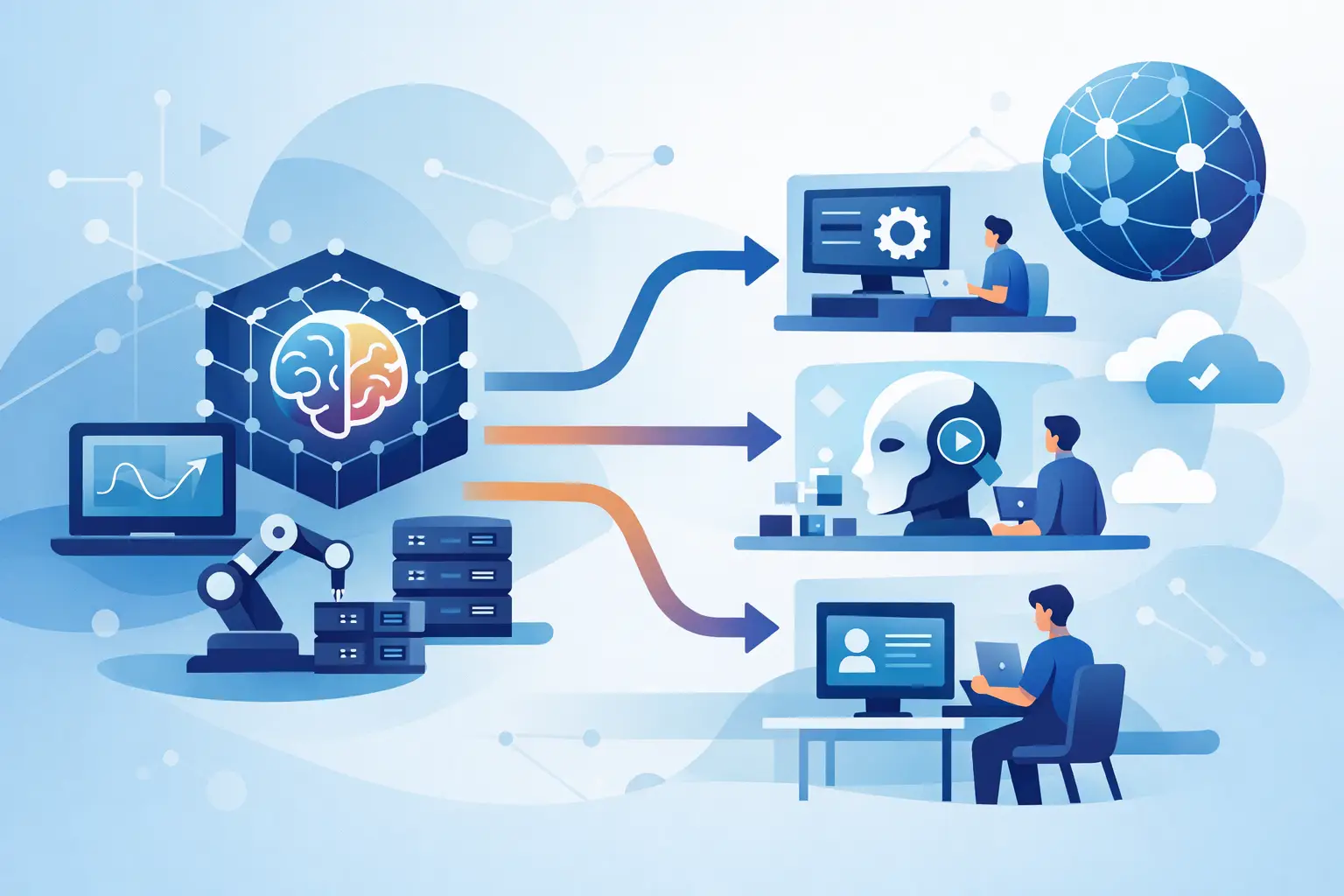
A production model routing guide starts with a less glamorous question than “which model is best?”: what should happen when a request is too sensitive, too expensive, poorly matched, or sent to an unavailable provider? Teams running LLM features at scale need an answer that is consistent across products, teams and providers. That means treating routing as a governed control-plane decision, not a model selection preference embedded in application code.
The goal is not to send every prompt to the cheapest model. It is to send each request to the least expensive model that can meet the task’s quality, latency, security and policy requirements - while retaining an accountable record of what occurred.
What model routing means in production
Model routing is the process of selecting an LLM for an individual request according to defined rules and priorities. A useful router can consider task type, required capability, provider availability, model cost and operational constraints. In a production environment, that decision also needs to sit alongside data protection, prompt-injection controls, output moderation and spend controls.
This is materially different from setting a single provider and model name in an application configuration file. A single-model integration is easy to begin with, but it makes every workload share the same cost profile, performance characteristics and provider dependency. A short classification task, a document extraction workflow and a high-stakes customer response rarely need the same model.
The operational challenge is that applications should not need to carry this logic themselves. If every service contains its own provider fallbacks, model comparisons and policy checks, governance becomes fragmented. Changes require repeated code deploys, and no central team can confidently explain why a particular request went where it did.
A governed routing layer creates one doorway between applications and model providers. Applications send compatible requests to that doorway; routing rules and request-level policies determine the rest.
Begin with workload classes, not a model leaderboard
The right routing strategy depends on the work being performed. Benchmark scores are useful inputs, but they are not a routing policy. A model that is excellent at complex reasoning may be unnecessary for structured extraction. A lower-cost model may be appropriate for summarising internal notes but unacceptable for an externally visible decision where precision must be higher.
Start by separating traffic into meaningful workload classes. For many organisations, these include high-volume transactional tasks, retrieval-grounded support responses, internal drafting, structured data extraction and complex analytical work. Each class should have an owner, an expected quality bar, a latency expectation and a clear view of the data it is permitted to handle.
Then define the minimum capability needed for each class. “Best available” is not a requirement. “Accurately extract named fields from this document type within our response-time target” is. This distinction prevents expensive over-provisioning and makes later evaluation possible.
There will be exceptions. A low-cost route may work for 95% of requests but struggle with unusually long input, ambiguous instructions or a language-specific task. Your routing rules should make those exceptions explicit rather than allowing applications to make ad hoc changes. Named routes are useful here: they express an approved operational intent, while the underlying model priorities can evolve without business-logic rewrites.
Measure the trade-off before changing traffic
Cost is only meaningful alongside quality and failure behaviour. Before moving a workload, test representative prompts and assess the outputs against a defined acceptance standard. Include difficult cases, not only the happy path: incomplete input, conflicting instructions, sensitive data, unusual formatting and prompts that try to override system behaviour.
Evaluate latency at the same time. A more capable model can reduce retries or downstream manual review, which may justify a higher per-request cost. Conversely, a premium model used for routine classification can create spend with no measurable product benefit. Routing is an optimisation problem with several variables, not a race to the lowest token price.
Put security and governance before the routing decision
A routing design is incomplete if it assumes every incoming prompt is safe to process. Requests may include prompt-injection attempts, confidential information or personal data. Outputs may introduce content that should not reach an end user or an internal downstream system.
The order of controls matters. A defensible request path applies prompt shielding first, then DLP inspection, then routing, then output moderation. This sequence ensures that a malicious instruction is assessed before it influences model selection, and that sensitive values can be handled according to policy before a request reaches a provider.
DLP policy should be specific about the action taken when a match occurs. Depending on the use case, teams may log, warn, redact or block. Redaction replaces detected values with [REDACTED]; it is not tokenisation, and it does not provide a value-restoration mechanism. For workflows that cannot function without particular personal data, the appropriate answer may be a narrowly approved route and explicit controls, rather than a broad exception applied everywhere.
Logging requires the same discipline. Full prompt and response storage can create an avoidable data-retention risk. Metadata-only logging by default gives engineering teams useful operational evidence without routinely retaining payloads. Where payload retention is genuinely required for debugging or investigation, it should be an explicit opt-in decision with a clear owner and retention approach.
Make failover deliberate, not accidental
Provider outages and intermittent model errors are normal operational conditions. Automatic failover can preserve service continuity, but it should follow an approved priority order. The fallback model must be capable of handling the task and allowed by the same data and policy requirements.
Do not assume that any available provider is an acceptable substitute. A regulated workflow may have residency or contractual restrictions. A customer-facing workflow may require a fallback that maintains a particular quality threshold. For low-risk internal drafting, a broader fallback pool may be reasonable. The correct choice depends on the workload class and its controls.
Per-request traces turn this from a black box into an operational system. A trace should allow a team to see the route considered, the model selected, the policy outcomes, the fallback path where relevant, latency and cost-related metadata. That evidence helps engineers investigate incidents, FinOps teams understand spend patterns, and compliance teams support audit records.
Control spend separately from quality routing
Routing rules can reduce spend by matching capability to the job. Hard spend caps serve a different purpose: they enforce a financial boundary. They should not be treated as a hidden quality-control mechanism or a signal to reroute requests automatically to an unsuitable model.
When a hard cap is reached, the intended behaviour is to alert or block the request with a 429 response. This makes the constraint visible to the calling system and prevents uncontrolled consumption. Product teams can then decide whether to degrade gracefully, queue work, request a budget change or provide a different user experience.
Budget ownership also needs to reflect how AI is consumed. Central platform teams may own shared controls, while product teams need visibility into their routes and usage. Scoped API keys, route-level reporting and per-request traces make that allocation more practical than a single provider bill shared across an entire organisation.
Deploy routing without rewriting applications
The lowest-friction adoption path is to preserve the application’s existing OpenAI-compatible client behaviour and change only the API key and base URL. Business logic stays byte-for-byte identical while the control plane gains authority over routing and policy enforcement.
import os from openai import OpenAI
client = OpenAI( api_key=os.environ["ROUTEUR_KEY"], base_url="https://api.routeur.ai/v1", )
response = client.chat.completions.create( model="auto", messages=[ {"role": "user", "content": "Extract the invoice number and due date."} ], )
With model="auto", the application delegates the selection to approved routing rules. A plain logical route name can be used when the calling service has a known workload class that should follow a dedicated policy. The point is not to create another SDK abstraction for developers to learn. It is to centralise the decisions that should not be duplicated across every codebase.
routeur.ai is designed around this deployment model: one OpenAI-compatible endpoint, governed routing across providers, and policy enforcement on every request. For UK and EU organisations, EU data residency, GDPR processor terms and audit trails that support EU AI Act record-keeping make the operational model easier to evaluate alongside technical requirements.
Operate the routing policy as a living system
A routing configuration should be reviewed when workloads change, new models become available, quality signals shift or provider performance changes. The review does not need to become a weekly model fashion exercise. It should be driven by evidence: route-level cost, latency, acceptance rates, moderation outcomes, DLP events, failovers and user-impacting errors.
Set a regular cadence for route owners to inspect these signals and test proposed changes in dry-run mode before moving live traffic. This lets teams understand which model would have been selected without changing the actual request path. It is particularly useful when adjusting priorities, introducing a new provider, or validating whether a lower-cost model is suitable for a workload.
The strongest routing programmes make model choice boring. Developers retain a stable interface, security teams apply consistent controls, finance teams can enforce boundaries, and product teams get the capability each workflow needs. When the next model release or provider incident arrives, the useful question is no longer “which application needs changing?” It is “which governed rule should change, and what evidence supports it?”