
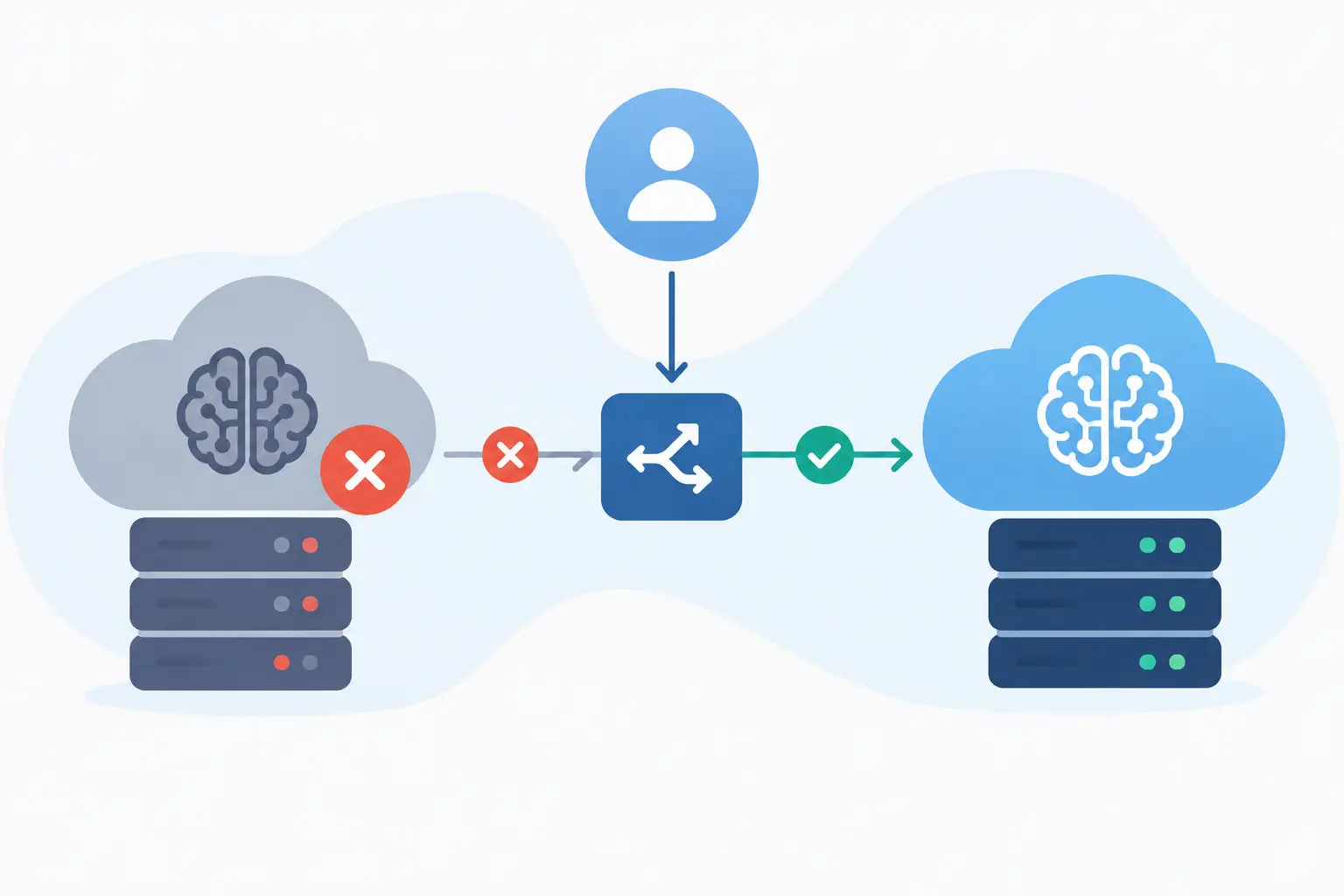
A provider outage is rarely the only failure mode worth planning for. A model can remain reachable while returning elevated errors, breaching latency targets, rejecting a workload because of capacity constraints, or becoming unsuitable for a particular task. Provider failover alternatives therefore need to preserve more than availability: they need to preserve application behaviour, security controls, spend discipline and evidence of what happened to each request.
For teams operating LLM features in production, the central question is not simply, “Can we send traffic somewhere else?” It is whether that decision can be made consistently, safely and without turning every application into a bespoke routing engine.
What provider failover must actually solve
A simple fallback sequence looks attractive: call Provider A, then retry with Provider B if the request fails. It is useful for narrow workloads, but it leaves difficult decisions inside the application. What counts as a failure? Which errors are safe to retry? Does the fallback model have the right capability, latency profile and data-processing posture? How do you avoid duplicate work when a timeout masks a completed request?
Those questions multiply across products, teams and environments. One service may use exponential backoff, another may fail open to a lower-cost model, and a third may have no fallback at all. The result is uneven resilience and limited visibility during an incident.
A production design should distinguish between provider unavailability and model suitability. A highly capable reasoning model may not be the right substitute for a high-volume classification workflow. Equally, routing all traffic to a premium fallback during an outage may protect availability while creating an avoidable cost event.
Provider failover alternatives: five operating models
There is no universal replacement for provider failover. The appropriate approach depends on traffic volume, tolerance for degraded results, regulatory requirements and the operational maturity of the team.
1. Application-level retries and fallbacks
The most direct option is to build retry and fallback logic into each application. Engineering teams retain complete control over decision-making and can tune behaviour for a specific workflow. For a single service with a limited number of prompts, this can be reasonable.
The trade-off is maintenance. Every application must classify errors, manage timeouts, prevent duplicate requests, select alternatives and record decisions. Security and DLP controls must also be applied before each provider call, rather than once at a common boundary. As the provider estate grows, application-level logic becomes difficult to audit and harder to change without deployments.
This model suits highly specialised workflows where fallback behaviour is genuinely part of the product logic. It is less suitable as a shared control mechanism for an organisation-wide AI estate.
2. Provider-native resilience features
Some providers offer regional endpoints, capacity options or internal retries. These can reduce the likelihood of individual service disruptions and should form part of a provider-specific reliability assessment.
They do not, however, create provider independence. An incident affecting a provider’s control plane, account access, model availability or policy enforcement can still affect every workload tied to that provider. Native features also cannot apply a consistent selection policy across providers, nor can they provide a single record of routing decisions across the estate.
Use provider-native resilience where it is available, but treat it as one layer rather than the entire continuity plan.
3. Queue-based degradation for non-interactive work
For document processing, enrichment, batch generation and internal automation, the best alternative may be to avoid immediate failover altogether. Place the work on a durable queue, retry later and expose a clear status to downstream systems.
This approach prevents an outage from creating a surge of duplicate calls or forcing a weaker model into a task that requires high accuracy. It is especially valuable where correctness matters more than immediate completion. The cost is delayed delivery, which makes it unsuitable for interactive copilots and customer-facing chat experiences.
A mature architecture often combines queues for asynchronous work with immediate routing decisions for user-facing requests.
4. Active-active application design across providers
Some organisations send meaningful production traffic to more than one provider under normal conditions. This validates credentials, model compatibility, prompt behaviour and capacity before a major incident occurs. It can also reduce the risk of discovering during an outage that an assumed substitute changes output quality or tool-calling behaviour.
The operational cost is substantial. Prompts, evaluation sets and release processes must account for model variation. Teams need clear criteria for which workloads can move between providers and which require a named model. Data handling assessments must cover every destination that may receive traffic.
Active-active design is most justified for high-value, latency-sensitive services with the engineering capacity to continuously test their alternatives. It is not automatically better than a carefully governed priority route.
5. A governed routing layer
A routing layer centralises provider selection, priorities, failover policy and observability behind one API boundary. Applications request a logical route or use model="auto"; the control plane decides which approved provider and model should receive the request.
This model is designed to separate business logic from infrastructure decisions. Rather than modifying each service when a provider changes state, platform teams update named routes and routing rules centrally. The application continues to use the same interface, while per-request traces show the outcome and the decision path.
For example, an OpenAI-compatible client can be directed to one governed doorway with a base URL and key change:
import os from openai import OpenAI
client = OpenAI( api_key=os.environ["ROUTEUR_KEY"], base_url="https://api.routeur.ai/v1", )
response = client.chat.completions.create( model="auto", messages=[{"role": "user", "content": "Summarise the incident update."}], )
With routeur.ai, existing application logic can remain byte-for-byte identical while routing and policy decisions move to the control plane. That matters when many teams share the same providers but must operate under different approved routes, budgets or data-handling requirements.
Failover should not bypass governance
A common design error is to treat resilience as a separate concern from security. Under pressure, teams may create a direct fallback path that bypasses normal inspection and logging. That path can become the least governed route in the system precisely when traffic is highest.
A governed request flow applies controls before provider selection. The sequence should be explicit: prompt shield first, then DLP, then routing, then output moderation. Sensitive data can be logged, warned on, redacted as [REDACTED], or blocked according to policy before it reaches an external model. Output moderation then assesses the returned content after the provider response.
This ordering has practical consequences. A fallback provider should not receive a different version of policy enforcement simply because it is only used during an incident. Similarly, metadata-only logging by default limits unnecessary payload retention while retaining per-request operational evidence. Payload retention should remain an explicit opt-in decision.
Define failover policy by workload, not by provider list
A list of approved providers is not a failover strategy. Each workload needs an operational policy that reflects what it is trying to protect.
For a customer support assistant, low latency and continuous response may justify automatic movement to an approved alternative model, provided quality has been evaluated. For legal drafting, a delayed response may be preferable to a lower-confidence substitute. For a data-sensitive internal workflow, the fallback route may be limited to providers approved for that data classification and EU processing requirements.
The policy should also describe what happens when no suitable alternative exists. A controlled failure with a clear user message is often safer than a silent downgrade. Teams should predefine acceptable latency, quality and cost boundaries, then test the decision using representative prompts rather than relying on model marketing claims.
Hard spend caps require similar clarity. A cap can alert or block further usage with a 429 response; it should not quietly reroute traffic to another model. Cost controls and availability controls solve different problems, and combining them without explicit policy creates surprising behaviour during an incident.
Test the route before the incident
Failover that has not been exercised is an assumption. Run controlled tests using a named route or provider and model override where appropriate, then inspect per-request traces for latency, provider selection, errors and policy actions. A dry run can help teams validate routing decisions without sending production traffic through an untested path.
Testing should include more than an artificial provider error. Assess timeouts, rate limits, malformed responses, output quality changes and prompt-injection attempts. Confirm that DLP outcomes remain consistent across the primary and fallback paths, and that scoped API keys only permit the intended routes.
Keep an incident runbook short enough to use under pressure. It should identify who can change route priorities, which workloads may degrade, where traces are reviewed and when a temporary rule must be removed. The aim is not to eliminate every outage. It is to ensure that an outage does not force improvised decisions about data, cost or customer experience.
The strongest provider failover alternative is usually not a more elaborate retry loop. It is a tested operating policy, enforced at one governed doorway, that lets teams choose continuity deliberately when conditions are least forgiving.