
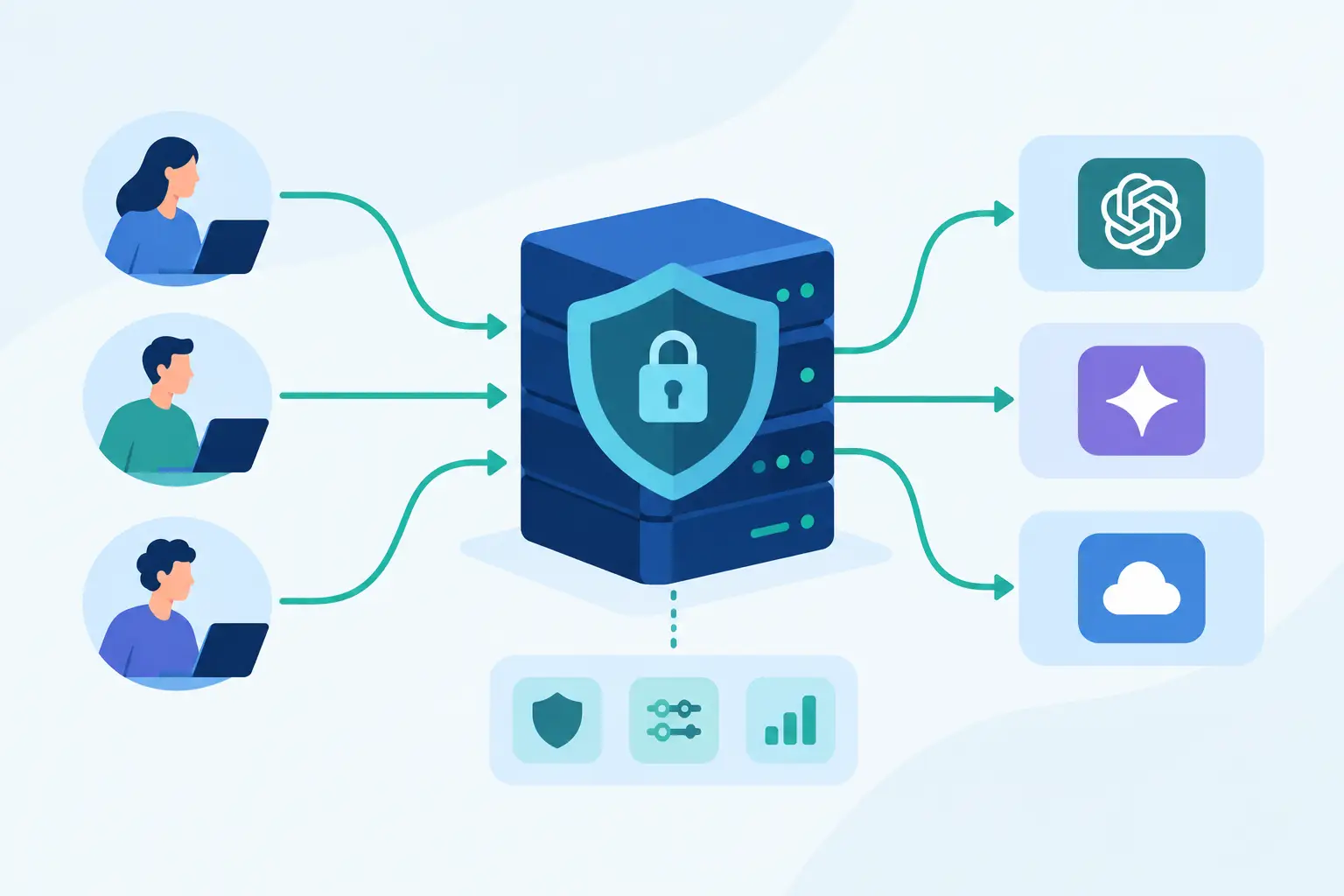
A production LLM integration rarely stays simple for long. One application starts with a single provider and model, then product requirements introduce lower-cost tasks, higher-quality tasks, regional data requirements and a need to explain who sent what, where, and under which policy. An LLM proxy puts one governed doorway between those applications and model providers, so those decisions are made consistently for every request rather than reimplemented in every service.
For engineering teams, this is not primarily a change to prompting or application behaviour. It is an infrastructure decision: centralise the controls that should apply regardless of whether a request ultimately reaches OpenAI, Google Gemini, Anthropic Claude, Mistral, Cohere or DeepSeek.
What an LLM proxy does
An LLM proxy receives an application request through a compatible API, evaluates it against centrally managed controls, selects an appropriate upstream destination and returns the response. The useful distinction is that it operates in the request path. It can therefore enforce policy before a prompt leaves your environment, record the operational evidence needed after the request completes, and make routing decisions from a single control plane.
That makes the proxy different from a dashboard that reports spend after the fact, or a provider abstraction library embedded in each application. Reporting can identify a problem. An SDK can simplify a local integration. Neither necessarily gives platform, security and FinOps teams one place to apply the same rule to every workload.
A well-designed proxy should preserve the application contract. Teams should not need to rewrite business logic merely to add routing, data controls or tracing. With an OpenAI-compatible gateway, the practical change can be limited to the API key and base URL while the calling code remains byte-for-byte identical.
The request path is the control point
The order of enforcement matters. A proxy is not simply a traffic distributor, because cost and availability are only part of a production decision. The safe sequence is to inspect the request before selecting a provider, then inspect the result before it reaches the user or downstream system.
At routeur.ai, the request path follows a defined sequence: prompt shield, DLP, routing, then output moderation. Prompt shielding identifies prompt-injection and jailbreak attempts first. DLP then applies the organisation's configured action when sensitive information is detected: log, warn, redact or block. Redaction replaces the relevant content with [REDACTED]; it does not create a recoverable token or restore the original value later.
Only then does routing take place. This prevents a supposedly economical route from becoming the path that accidentally exports information a policy should have stopped. After the selected provider returns a response, output moderation assesses that output before it is released.
This sequencing is particularly relevant for internal copilots and automated workflows. A support assistant may receive customer data; a document workflow may process employee information; an agent may ingest untrusted text from a third-party system. In each case, the request should be governed before model selection, not reviewed as an afterthought.
Routing should express intent, not provider loyalty
The strongest case for multi-provider routing is not that one model is always best. It is that tasks differ. Classification, extraction, customer-facing drafting, coding assistance and complex reasoning have different quality, latency and cost requirements. Providers also have changing capacity and intermittent failures.
Named routes, routing rules and priorities let platform teams express these choices once. A general workload can use auto, allowing the proxy to select the most cost-effective capable model according to the active routing rules. A workload with a specific requirement can target a plain logical route name instead. Automatic failover can move requests when an upstream provider is unavailable, subject to the route configuration and policy.
There are trade-offs. More routing flexibility can reduce provider concentration and improve cost control, but it also requires deliberate evaluation. A low-cost model may be sufficient for tagging calls but unsuitable for a regulated decision-support flow. A sensible routing policy is based on tested capability thresholds, expected latency and the consequences of a poor answer, rather than a blanket preference for the cheapest model.
Spend control needs an enforcement mechanism
Token spend becomes difficult to manage when each team holds separate provider credentials and experiments independently. By the time finance sees a monthly bill, the architecture has already made the decision. An LLM proxy moves spend management into the request path, where it can be associated with routes, scoped API keys and usage policies.
Hard spend caps are important because they define what happens when a limit is reached. They can alert or block further usage with a 429 response. They do not silently reroute traffic to a cheaper model once a budget threshold is crossed. That distinction matters: a cap is an explicit business control, while routing remains a separately configured capability decision.
The operational benefit is shared visibility. Engineering can see which routes and models carry volume. FinOps can identify cost patterns at request level. Product teams can decide whether a feature's quality justifies its model choice. This is more useful than a single provider invoice because it connects spend to the application behaviour that created it.
Logging must support evidence without creating a second data problem
LLM observability has a tension at its core. Teams need enough evidence to troubleshoot latency, failures, route decisions and costs. But retaining full prompts and outputs by default can create unnecessary exposure, especially where those payloads may contain personal or commercially sensitive data.
Metadata-only logging by default resolves much of that tension. Per-request traces can record operational details such as route selection, provider outcome, latency, usage and policy events without making payload retention the default. Full payload retention should be an explicit opt-in decision, made for a defined diagnostic or assurance purpose and governed accordingly.
For UK and EU organisations, this also supports a more practical compliance posture. EU data residency, GDPR processor terms and audit trails that support EU AI Act record-keeping are not replacements for an organisation's own governance responsibilities. They do, however, reduce the gap between an AI policy written by compliance and the technical evidence available when that policy is reviewed.
Where an LLM proxy fits in the architecture
The proxy should sit between applications and all approved model providers. Applications authenticate with scoped API keys to the proxy rather than carrying separate upstream credentials throughout the estate. The platform team defines routes, priorities, security controls, budgets and logging expectations centrally.
This architecture has a useful side effect: provider changes stop being application releases. When a team needs to introduce a new approved provider, adjust a route priority or apply a stricter DLP action, those changes can be made at the control layer. No code deploys are needed for each consuming application, provided its existing API usage remains compatible.
That does not mean every decision should be centralised without consultation. Product owners still need ownership of task quality. Security teams must define acceptable handling for sensitive data. Platform teams need to test failover and evaluate models against representative workloads. The proxy provides the common enforcement point; it does not eliminate the need for clear operating ownership.
Questions to ask before adopting one
Start with the requests already in production. Which applications call models directly? Which provider keys are distributed across teams? Which workloads may contain PII or confidential data? Which failures would interrupt a customer journey or an automated process? These questions reveal whether the immediate priority is governance, resilience, cost visibility or all three.
Then test the gateway against real traffic patterns. Confirm compatibility with existing client behaviour, assess route quality on representative prompts, validate the prompt shield and DLP actions, and inspect the traces your teams will use during an incident. Use dry-run capability where appropriate to understand routing and policy outcomes before applying a configuration to live traffic.
An LLM proxy is most valuable when it becomes ordinary infrastructure: one governed doorway that makes the approved path easier than the unmanaged one. Start with a contained production workload, establish the evidence and controls it needs, then extend that operating model as AI usage grows.