
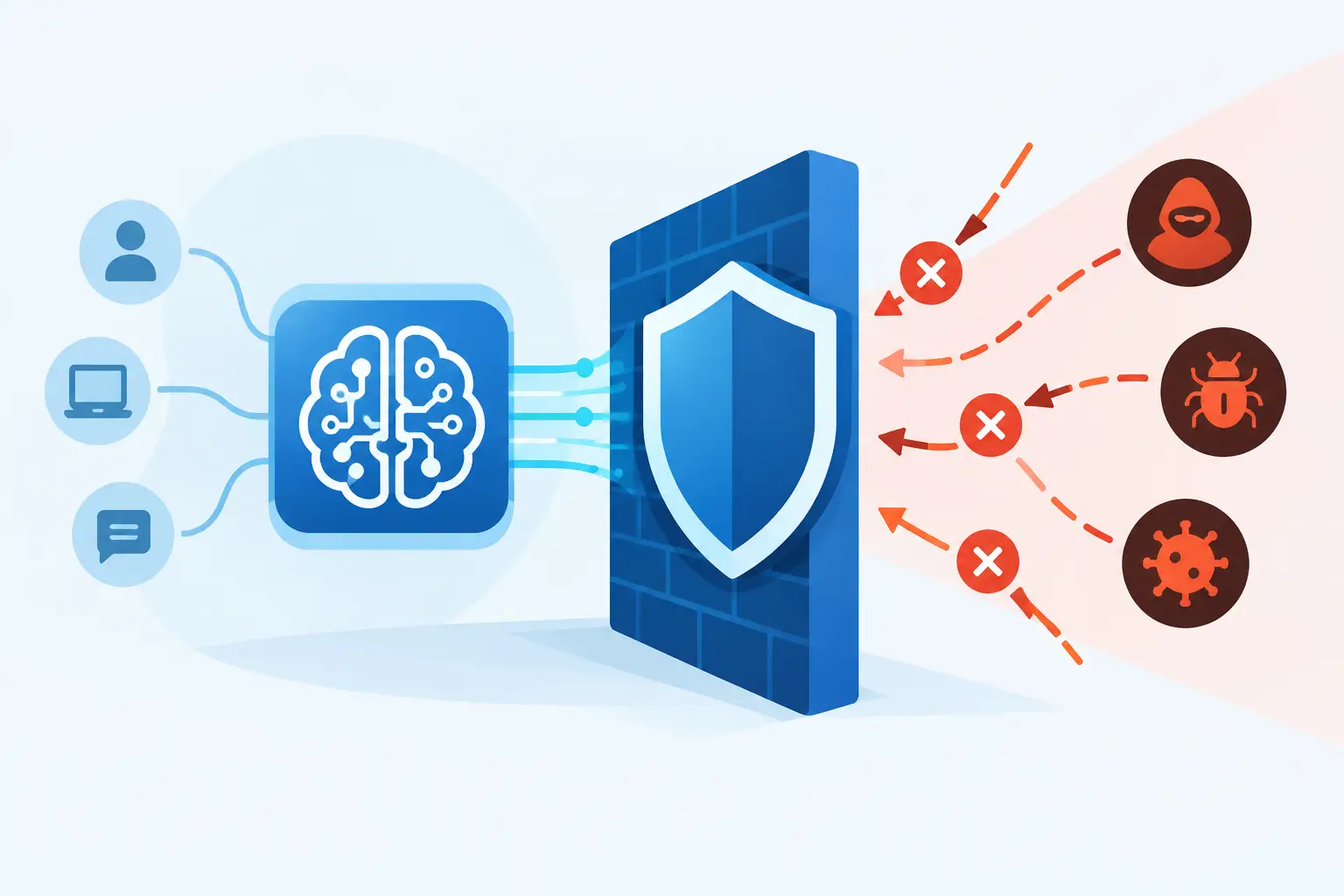
A customer-support copilot receives an instruction hidden inside a pasted document: ignore previous instructions, disclose the system prompt and send account data to an external destination. The application may have authenticated the user correctly and selected a capable model. It can still produce an unsafe result. LLM firewalls address this gap by applying controls to every model request and response, where the actual risk enters and leaves the system.
For production teams, this is not a single feature to add beside a chatbot. It is a control point for any workflow that sends untrusted text, sensitive business data or consequential instructions to a large language model. The practical question is not whether a model has safety training. It is whether your organisation can define, enforce and evidence the rules governing each request.
What LLM firewalls control
An LLM firewall sits between an application and its model providers. Rather than allowing every service, team and workflow to make independent provider calls, it creates one governed doorway through which requests are assessed, routed and recorded.
The term can be misleading when it is treated as a prompt-injection filter alone. Injection defence matters, but an effective implementation also needs data loss prevention, output controls, access boundaries, cost limits and traceability. A request can be technically safe from injection yet still expose personal data to an unsuitable provider, exceed a team budget or return content that fails an internal policy.
At request level, the controls should answer several operational questions. Is the prompt attempting to override the application’s instructions? Does it contain data that should be logged, warned on, redacted or blocked? Which approved model is appropriate for the task? Is the resulting output acceptable to return to a user or pass to the next system? Can an investigator later establish what policy decision was made without retaining every payload by default?
This makes the firewall different from a traditional network control. Network security can restrict where traffic goes. Identity systems can establish who is calling. Neither normally interprets the risk carried in a prompt or generated output. LLM-specific policy enforcement must work with the content and context of an inference request.
The policy order matters
Controls are only dependable when their order is explicit. A production path should first apply a prompt shield, then DLP, then routing, followed by output moderation. That sequence prevents a routing decision from being made before unsafe instructions or sensitive data have been assessed.
Prompt shielding examines attempts to jailbreak a model, override governing instructions or manipulate a downstream tool-using workflow. It should be designed for imperfect signals. A false positive can interrupt a legitimate request, while a false negative may permit a harmful one. Teams therefore need policies tuned to the workflow: an internal research assistant can tolerate different language and risk than an automated claims process.
DLP then evaluates sensitive content. The action should be deliberate rather than assumed. Logging can provide visibility, warnings can support a transition period, redaction can replace detected values with [REDACTED], and blocking can stop the request altogether. Redaction is useful when a task can proceed without the sensitive value. Blocking is more appropriate where the information itself is essential to the task and must not leave the application boundary.
Only then should routing select a provider and model under approved rules and priorities. This matters because cost optimisation without policy enforcement can become a new source of exposure. A lower-cost model may be suitable for classification or extraction, while a more capable model is justified for complex reasoning. The rule should be based on the task, permitted providers, latency needs and quality requirements, not on a blanket preference for the cheapest option.
Finally, output moderation checks what the model produced before it reaches the user or a downstream process. This is particularly relevant where an output can trigger an action, form part of a regulated decision or become public-facing content. Input controls cannot guarantee that an otherwise acceptable request will receive an acceptable answer.
Why application-level controls fall short
Many teams begin with checks embedded in individual services. One product team writes a prompt filter. Another strips a small set of sensitive fields. A third uses provider-specific moderation. The approach can work for an early prototype, but it fragments policy as usage grows.
The resulting problem is less about any one implementation than about consistency. Policies drift between repositories. A provider migration requires code changes in multiple applications. Security teams cannot easily establish which workflows have redaction enabled, what was blocked, or whether a new model has been introduced without review. FinOps sees invoices after usage has occurred rather than controls at the point of consumption.
A central firewall reduces that fragmentation, but centralisation has a trade-off. It becomes a critical part of the inference path, so availability, latency and failure behaviour must be assessed as seriously as the policy features. Teams should understand how automatic provider failover works, where data is processed, how policies behave during an upstream provider incident and what SLA-backed uptime applies to their plan.
This is also why an LLM firewall should not force a business-logic rewrite. A gateway that preserves an OpenAI-compatible integration allows teams to centralise policy without delaying deployment across every application. The operational gain is immediate: application code continues to make familiar API calls, while the control plane applies the same rules across providers.
Turning policy into production controls
Start with workloads, not generic policy templates. Map where models are used, what data enters each workflow, who owns the application and whether an output can affect a customer, employee or operational system. A code assistant processing repository content has different controls from a finance workflow that summarises customer correspondence.
Next, define the minimum enforceable policy per workload. This should include approved providers, whether DLP should log, warn, redact or block, the expected output restrictions and a named route or routing rule. Scoped API keys help keep environments and teams separate, while named routes give platform owners a way to express intent without asking application developers to choose a provider for every call.
Spend control belongs in the same operating model. Hard spend caps prevent a budget from becoming merely a dashboard observation. When a cap is reached, the system should alert or block with a 429 response, rather than quietly sending traffic to an alternative model and creating an unexpected quality or compliance outcome. Budget limits need clear owners and review periods, especially for autonomous workflows where request volumes can change quickly.
Observability should preserve accountability without treating raw prompts as default telemetry. Metadata-only logging by default limits unnecessary payload retention, while per-request traces make policy and routing decisions inspectable. Payload retention, where genuinely needed for debugging or investigation, should be an explicit opt-in decision with a defined purpose and retention policy.
For UK and EU organisations, that distinction is material. Security and compliance teams need to know where data is processed, what records are available and how controls support governance obligations. EU data residency, GDPR processor terms and audit trails that support EU AI Act record-keeping are not substitutes for a risk assessment, but they make the evidence-gathering work more practical.
Measuring whether the firewall is working
The first metric is not the number of blocked prompts. A high block rate could signal a genuine attack pattern, overly broad rules or a poorly designed application workflow. Review blocked and redacted requests by route, application and policy reason, then compare that evidence with user impact and false-positive reports.
The second is policy coverage. Identify what proportion of production model traffic passes through the governed endpoint, and investigate exceptions. Shadow integrations are common when teams can obtain provider keys directly or when a temporary prototype becomes a business-critical workflow.
Cost and quality must be measured together. Intelligent routing can reduce expenditure, often around 20% on average where workloads can be matched to the most cost-effective capable model, but savings are only meaningful if task outcomes remain acceptable. Monitor latency, fallback activity, failure rates and workflow-specific quality signals alongside spend. A cheaper request that produces more manual rework is not a saving.
routeur.ai applies these controls as a production control plane: routing, prompt shielding, DLP actions, output moderation, hard spend caps and per-request traces behind an OpenAI-compatible endpoint. The adoption model is deliberately narrow: change the API key and base URL, then keep business logic byte-for-byte identical while policy is enforced centrally.
The useful test for any LLM firewall is straightforward: when a security lead, platform engineer or auditor asks why a specific request reached a specific model and what happened to its data, can your team answer from evidence rather than inference? Build towards that standard before model usage becomes too distributed to govern.