
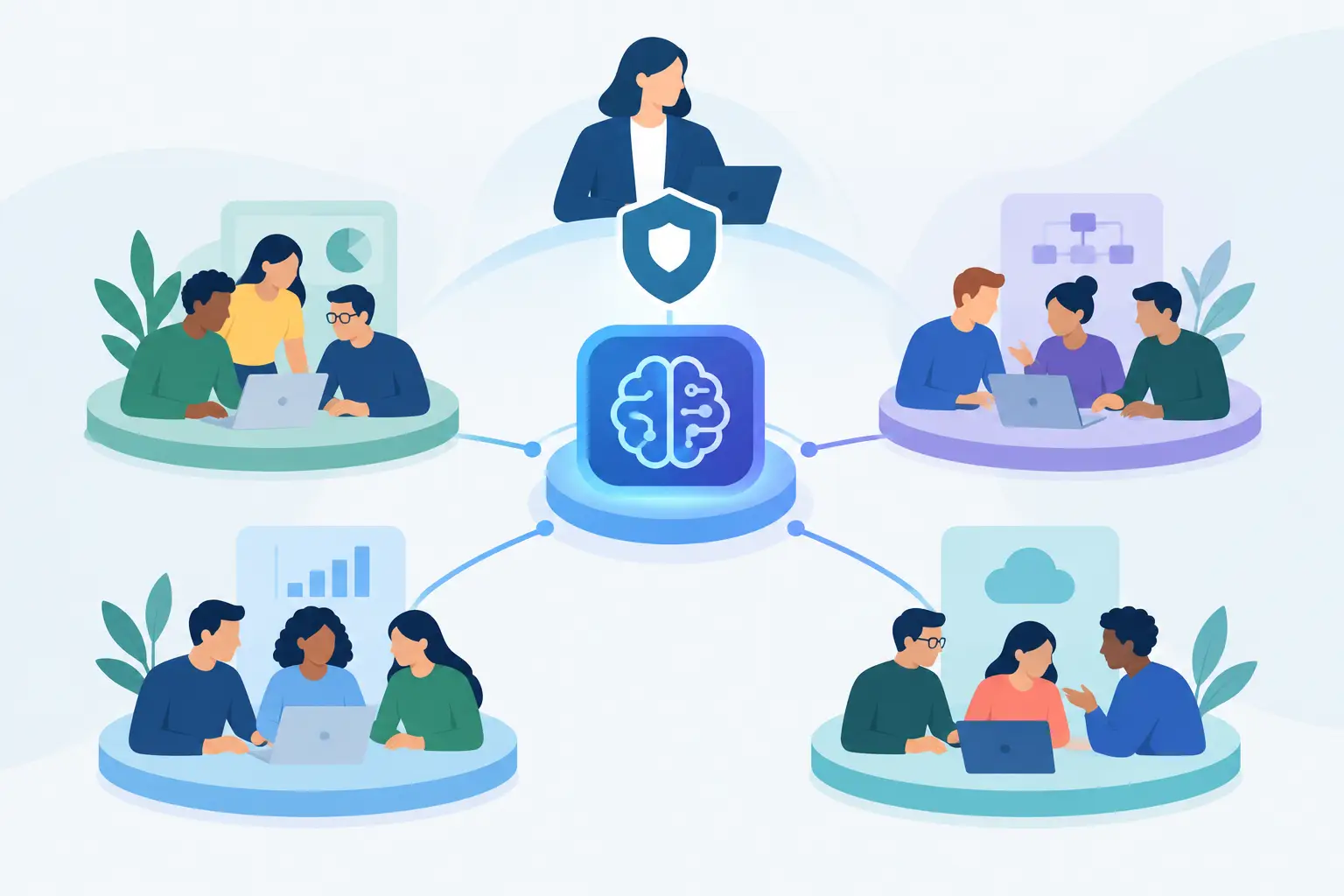
A product team ships an internal copilot. A second team adds document analysis. A third starts using LLMs in customer workflows. Within months, the challenge in scaling multi-team AI is no longer selecting a capable model. It is controlling dozens of independent requests, provider accounts, prompts, budgets and data-handling decisions without slowing delivery.
The failure mode is familiar: each team makes a reasonable local choice. They use the provider that best fits a feature, retain logs differently, set their own spend alerts and implement their own fallback logic. The organisation then inherits an AI estate it cannot view or govern as one system.
Why multi-team AI breaks at the boundaries
A single application can often manage a direct model-provider integration. Its owner knows the prompts, the expected volume and the appropriate model. That pattern does not hold when multiple teams build independently.
Spend becomes difficult to attribute. A costly model may remain attached to work that a lower-cost capable option could handle, while nobody has a full picture of request volume across products. Reliability decisions vary by team too: one service has a fallback path, another fails when a provider is unavailable, and a third quietly sends sensitive content to a new endpoint.
Security and compliance introduce a more serious boundary problem. Prompt injection shielding, PII treatment, output moderation and audit evidence cannot depend on whether every application team has implemented the same middleware correctly. They need to be enforced consistently at the request boundary.
This does not mean every team should use one model or follow one prompt template. Teams need room to make product decisions. The platform concern is different: create common controls around those decisions, with clear exceptions and evidence of how each request was handled.
Use one governed doorway for scaling multi-team AI
The practical architecture is a control plane between applications and model providers. Applications send requests through one governed doorway rather than connecting independently to OpenAI, Google Gemini, DeepSeek, Anthropic Claude, Mistral or Cohere.
That doorway should apply controls in a predictable order:
- Prompt shielding assesses requests for prompt-injection and jailbreak patterns.
- DLP evaluates sensitive information according to the required action: log, warn, redact or block. Where redaction is selected, the value becomes
[REDACTED]. - Routing selects an eligible provider and model using defined rules and priorities.
- Output moderation assesses the model response before it returns to the application.
The order matters. Sensitive content and malicious instructions should be handled before a request is routed externally. Likewise, output controls should apply to the returned response, not be left to every consuming application.
A central control plane also separates a team’s business logic from the infrastructure decisions that change most often. Providers change pricing, model capability and availability. Policy requirements change. A team building a claims assistant should not need to redeploy its application merely because the platform team updates a routing priority or DLP policy.
Deploy without creating an integration programme
Central governance fails when adopting it means rebuilding every AI application. The useful starting point is an OpenAI-compatible endpoint that preserves the existing client pattern.
For a Python application already using the OpenAI client, the application change can be limited to the API key and base URL. The request remains a normal chat completion request, and the application can use auto when central routing should select the model.
from openai import OpenAI import os
client = OpenAI( api_key=os.environ["ROUTEUR_KEY"], base_url="https://api.routeur.ai/v1" )
response = client.chat.completions.create( model="auto", messages=[ {"role": "user", "content": "Summarise this support case."} ] )
That small change has an operational benefit beyond speed. The application stays byte-for-byte identical in its business logic while routing, security and spend controls move to a layer that platform, security and FinOps teams can operate together.
Scoped API keys are particularly useful here. A key can represent the appropriate application or team boundary, allowing central teams to apply policy and understand usage without asking developers to introduce home-grown request tagging schemes.
Give teams choices, but define the decision rights
Centralisation should not become a bottleneck. The aim is to standardise the controls, not force every workload through identical settings.
Use routing rules for routine traffic
For most production traffic, routing rules and priorities should express the organisation’s default trade-offs: model capability, latency expectations, provider availability and cost. Automatic failover can reduce the impact of a provider outage without embedding provider-specific recovery logic in every service.
A named route is appropriate when a class of workload has a stable requirement that differs from the default. For example, a high-stakes workflow may need a tighter approved model set than an internal drafting tool. The route is a visible operational decision rather than an undocumented model name buried in application code.
The trade-off is that too many routes recreate fragmentation. Start with a small set based on genuinely different risk, quality or performance requirements. Review whether each route still earns its complexity.
Keep provider selection available for controlled evaluation
There are cases where a team needs to compare a particular provider or model for an experiment, regression test or incident investigation. That is reasonable, provided it happens within the same policy boundary and remains visible in request traces.
The platform team should define who can make those selections, for how long and in which environments. Experimentation is useful. Untracked production exceptions are not.
Treat budgets as controls, not forecasts
Budgets must work at the level where accountability exists: a product, environment, team or shared service. Hard spend caps provide a clear last line of defence. When a cap is reached, requests can be blocked with a 429 response rather than allowing an unexpected bill to grow overnight.
A cap is not a routing rule. It should not silently move traffic to another model. Cost optimisation decisions belong in routing policy; budget enforcement belongs in a clear control that alerts or blocks. Keeping those responsibilities separate makes incidents easier to diagnose and prevents surprise changes in application behaviour.
Make evidence useful without collecting everything
Scaling AI creates pressure to log more. That can solve one problem while creating another, particularly for regulated organisations handling customer, employee or commercial data.
Use per-request traces to establish what happened: which route applied, where the request went, the relevant timing and usage context, and whether policy controls acted. Metadata-only logging by default gives teams operational visibility without automatically retaining prompt and response payloads. Payload retention should be an explicit opt-in decision with a defined purpose and owner.
This distinction matters for both security and delivery. Engineers need enough evidence to investigate failures, explain cost changes and verify routing behaviour. Compliance teams need audit trails that support record-keeping without turning observability into uncontrolled data retention. For organisations operating in Europe, EU data residency and GDPR processor terms should be assessed alongside those logging choices, not after deployment.
A useful monthly review is not a dashboard tour. It should answer a short set of operational questions: Which teams are consuming the most budget? Which routes have the highest failure or fallback rates? Where did DLP or prompt shielding intervene? Which exceptions are now permanent enough to become formal policy? These questions turn traces into governance decisions.
Avoid the two extremes
The first extreme is decentralisation without guardrails, where every team owns its own provider logic and policies. It feels fast until costs, data exposure and incident response become shared problems.
The second is a central approval queue for every model change. That reduces local autonomy so sharply that teams work around it. The better model is a paved road: pre-approved routes, scoped access, request-level enforcement and a documented exception process for workloads that genuinely differ.
routeur.ai is designed for that middle ground. Its OpenAI-compatible gateway places routing, policy enforcement, traces and spend controls behind one endpoint, so governance can scale without requiring application rewrites.
Start with the services that reveal the gaps
Do not begin by migrating every AI feature. Start with two or three services that expose different operational needs: a customer-facing workflow, an internal assistant and a batch process handling sensitive documents. They will quickly show whether routes, DLP actions, spend caps and trace ownership are defined well enough.
Once those controls work under real traffic, expansion becomes an operational repeatable process rather than a series of bespoke integrations. The lasting advantage is not simply lower model cost or fewer provider connections. It is the ability to let more teams build with AI while keeping every request accountable to the same doorway.