
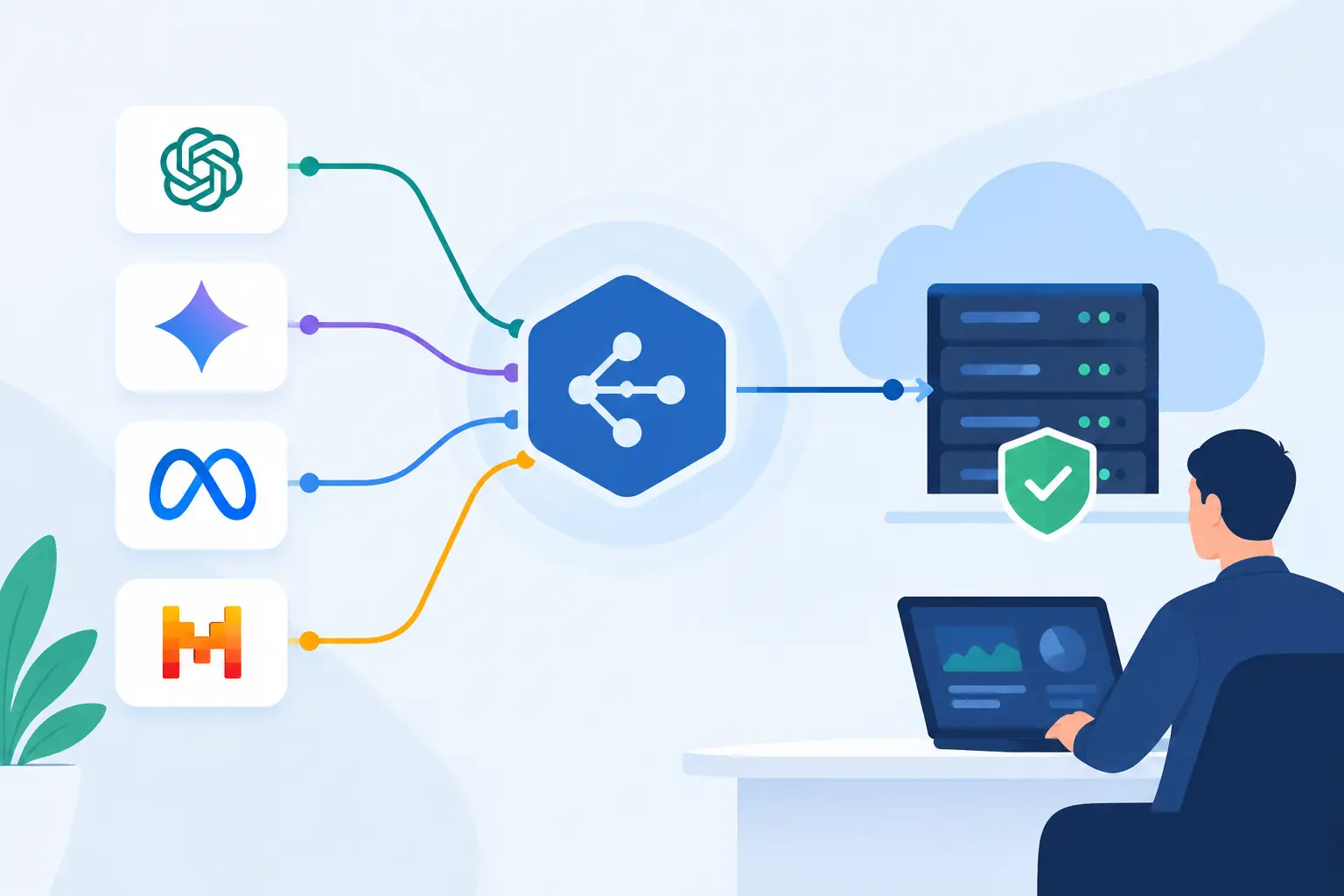
A model change should not become an application rewrite. Yet many teams still integrate each provider directly, then discover that changing model, enforcing a new policy or responding to an outage means touching several services, SDKs and deployment pipelines. That is why use compatible AI gateways is a practical production question, not a theoretical architecture choice.
An OpenAI-compatible gateway gives applications one familiar interface while creating one governed doorway to the model providers behind it. The application continues making the requests it already knows how to make. Platform, security and FinOps teams gain a control point where they can apply rules consistently, inspect operational traces and make provider decisions without embedding them in product code.
Compatible AI gateways separate application logic from provider choice
Most LLM applications begin with a direct provider integration. This is reasonable for a prototype: choose a model, add an API key and ship a useful feature. The operating model changes once that feature serves customers, handles internal data or becomes part of a business process.
Now the team needs to answer harder questions. Which model is appropriate for this request? What happens when a provider is unavailable? Can a team use a more expensive model without an approved budget? Has a prompt containing personal data left the company boundary? Can security prove which controls were applied to a request?
Without a gateway, those decisions tend to spread across applications. One team adds retry logic. Another builds a redaction function. A third keeps a separate cost dashboard. The result is duplicated middleware, inconsistent controls and provider-specific assumptions in business logic.
Compatibility changes the boundary. An OpenAI-compatible endpoint accepts the request shape teams already use, while the gateway handles routing and controls behind that endpoint. A minimal client configuration can look like this:
import os from openai import OpenAI
client = OpenAI( api_key=os.environ["ROUTEUR_KEY"], base_url="https://api.routeur.ai/v1", )
response = client.chat.completions.create( model="auto", messages=[ {"role": "user", "content": "Summarise this support case."} ], )
The base URL and API key change. The application’s request and response handling can remain byte-for-byte identical. That matters because changing provider infrastructure should not force product teams to retest unrelated business logic or learn a new SDK merely to gain central control.
Compatibility is not only about developer convenience. It preserves a clean ownership boundary. Product teams own what their applications ask and how they use the response. The AI platform team owns the routes, routing rules, priorities and governed controls that determine how requests are handled.
Why use compatible AI gateways for control, not just choice
Multi-provider access is often described as flexibility. Flexibility is useful, but production value comes from operating that choice under rules.
A compatible gateway can route a request to the most cost-effective capable model according to centrally managed priorities. It can also fail over when a provider has an issue, reducing the need for each application to implement its own provider-specific resilience pattern. Teams can define named routes where a workload requires a known set of model choices, while auto supports centrally managed selection.
There are trade-offs. Not every request should chase the lowest-cost model. A customer-facing legal workflow, for example, may require a higher-capability route and tighter evaluation. A high-volume classification task may be well suited to a lower-cost capable model. The key is that these decisions become explicit routing policy rather than hard-coded model names scattered across repositories.
This also reduces the operational cost of testing alternatives. A platform team can adjust priorities, assess per-request traces and compare outcomes without asking every application owner to release a new version. Provider choice remains available, but it is no longer uncontrolled.
For routeur.ai customers, this control plane combines multi-provider routing and automatic failover with governance at the same integration point. The aim is not to make model changes invisible to responsible teams. It is to make them manageable without unnecessary code deploys.
Apply security policy before the model sees the request
A gateway is only useful as a security boundary if its controls run in a clear, reliable order. The request path should be understandable by engineering and auditable by security.
The routeur.ai policy sequence is deliberate: prompt shield first, then DLP, then routing, then output moderation. Prompt-injection and jailbreak shielding assesses the incoming instruction before provider selection. DLP then applies the configured action to detected sensitive information: log, warn, redact or block. Redaction replaces the detected content with [REDACTED]; it does not tokenise information or provide a value-restoration mechanism.
Only after those input controls does routing select the provider and model. Output moderation evaluates the model response before it is returned to the application. This ordering prevents an architecture where security checks are treated as optional post-processing after sensitive content has already been sent onwards.
Centralisation matters here. If every product implements its own filters, coverage varies by language, release cadence and engineering capacity. A request-level control plane applies the same policy to every connected application. Scoped API keys provide a further boundary so credentials can be limited to the appropriate usage context rather than shared broadly.
No gateway removes the need for application-level authorisation, careful prompt design or evaluation. It does establish a consistent enforcement point for risks that otherwise multiply as LLM use spreads across teams.
Spend controls work best when they can enforce a decision
Cost visibility after month-end is not cost control. By then, an inefficient route, an unexpected traffic pattern or a compromised key may already have created a material bill.
Compatible gateways bring cost decisions into the request path. Per-request traces show the routing decision and relevant metadata, helping teams locate expensive workloads and verify whether intended routes are being used. Hard spend caps and budgets can alert or block usage when limits are reached. When a hard cap blocks a request, the gateway returns a 429 rather than quietly rerouting traffic around the control.
That distinction is important. A budget is a governance decision, not a hint to find another way to spend. Teams can deliberately set separate limits for environments, applications or routes, then decide whether a blocked request should be retried later, handled with a product fallback or escalated operationally.
Savings depend on the workload mix, model quality requirements and current provider pricing. For organisations with suitable routing opportunities, routeur.ai reports about 20% average savings. The more durable benefit is knowing why a request used a particular model, what it cost and whether it complied with the organisation’s rules.
Audit evidence should not require collecting every payload
Regulated and security-conscious teams need evidence that controls exist and are operating. They also need to avoid turning observability into an unnecessary store of sensitive prompts and outputs.
Metadata-only logging by default addresses that tension. Teams can retain request-level trace information needed for operational analysis and audit trails without retaining full payloads automatically. Payload retention is an explicit opt-in decision, allowing organisations to set different practices for development, incident investigation and production workloads.
For UK and EU organisations, data location and record-keeping are part of the architecture decision. EU data residency in GCP europe-west1, GDPR processor terms and audit trails that support EU AI Act record-keeping provide a clearer foundation than trying to reconstruct evidence across separate provider accounts and application logs.
A compatible gateway will not make every compliance obligation disappear. It gives compliance, engineering and security teams a shared place to define controls and inspect how requests moved through them.
Adopt compatibility without creating a second platform project
The strongest reason to use a compatible AI gateway is implementation speed with retained control. A new abstraction can be costly if it requires every team to replace SDKs, revise prompts or alter response handling. An OpenAI-compatible endpoint avoids much of that adoption friction.
Start with one production workflow that has clear volume, cost or governance pressure. Configure the client with the gateway base URL, use auto or a plain logical route name, then examine traces before extending usage. Enable tracing when needed with Routeur-Trace, and use dry runs where appropriate to validate routing decisions before changing live behaviour. Keep route policy owned by a small group with clear accountability, rather than allowing model selection to become an unreviewed application setting.
The useful test is simple: when the next provider change, security requirement or budget decision arrives, can the organisation act at one governed doorway rather than opening a change request across every application? If the answer is yes, AI infrastructure has started to serve production operations rather than complicate them.