
A provider outage is not the only reason to introduce routing. The best AI provider routing tools give engineering teams a controlled way to choose models by capability, cost, data policy and availability - without embedding provider-specific decisions throughout every application.
For a production team, the question is not simply which gateway can send a prompt to several model vendors. It is whether the routing layer can make those decisions predictably, expose why they were made, and enforce the same controls for every request. That distinction determines whether multi-provider AI reduces operational risk or merely creates another integration to maintain.
What AI provider routing must solve in production
Most teams begin with one model and one direct API integration. That is a sensible starting point. Complexity arrives when different workloads need different trade-offs: a low-cost model for classification, a higher-capability model for contract analysis, or a fallback when a preferred provider is unavailable.
Direct integrations turn those choices into application logic. Teams then need separate provider clients, model-specific error handling, usage reporting, credentials, security checks and release processes. Every product team can make a slightly different decision, leaving the platform team with inconsistent controls and incomplete evidence.
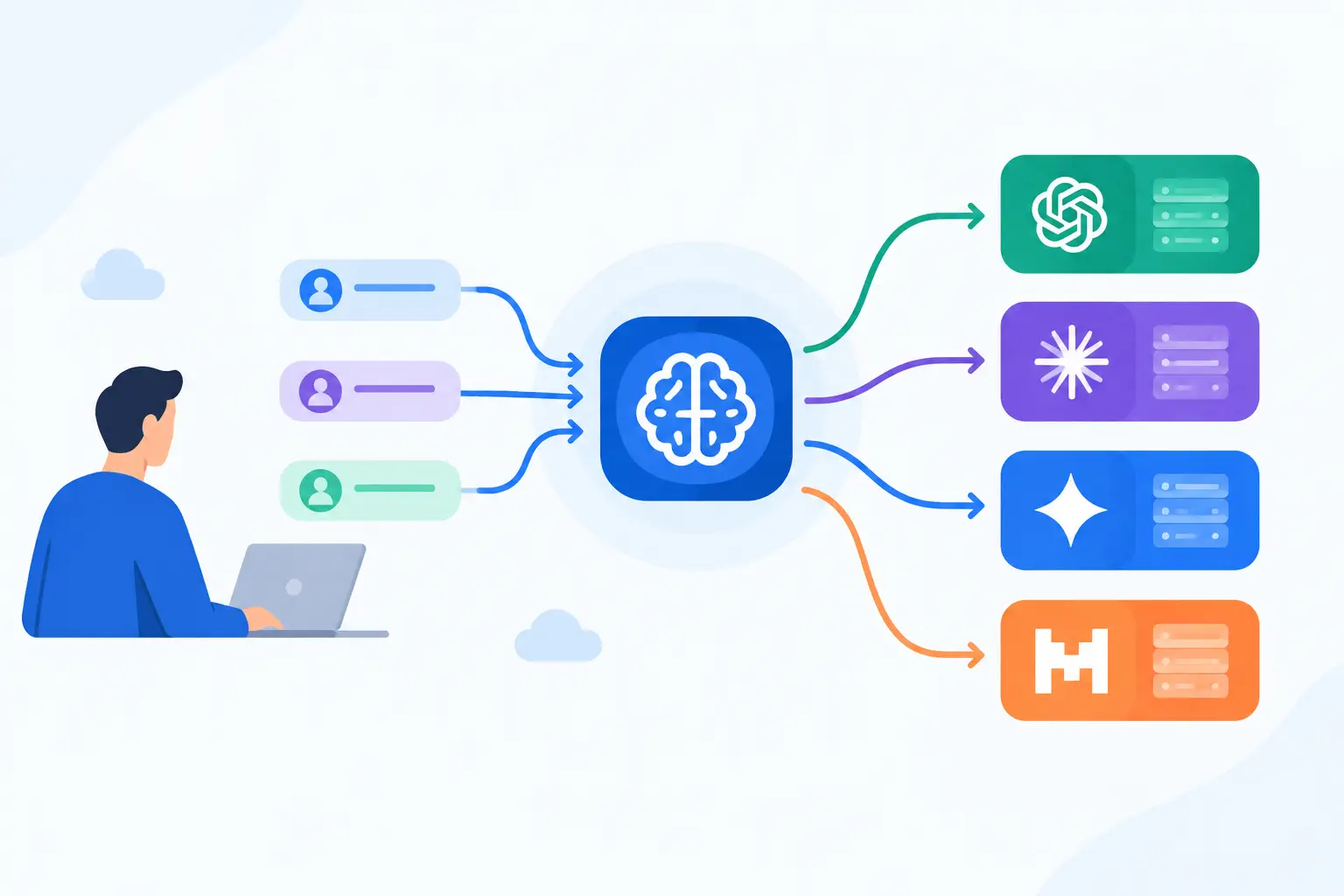
A routing tool should create one governed doorway between applications and providers. Applications call a stable, compatible endpoint; the control plane applies policy, selects an eligible destination and records the decision. The application should not have to know whether the request is served by OpenAI, Google Gemini, Anthropic Claude, Mistral, Cohere or DeepSeek.
That architecture matters most where AI is already part of a customer product, internal copilot or automated business process. At that point, cost, availability and data handling are operational concerns, not experiments for individual developers to solve independently.
How to assess the best AI provider routing tools
A feature checklist can be misleading. A tool may advertise many providers but offer little control over how requests reach them. Assess the full request path instead: what enters the platform, which policies apply, how a route is selected, what happens on failure and what evidence remains afterwards.
Routing should be explicit, not opaque
A useful routing layer supports an automatic option for workloads where the platform can select the most cost-effective capable model. It should also support named routes for cases where a team needs a clear operational contract, such as a route reserved for a customer-facing assistant or a regulated workflow.
Look for routing rules and priorities that can express real constraints. Capability is only one input. Provider availability, approved regions, workload sensitivity and cost objectives may all limit the valid choices. The system should explain the final provider and model selection in a per-request trace rather than treating routing as an unexplained black box.
There is a trade-off here. Fully automatic selection reduces manual tuning, but it is not suitable for every workflow. Product teams may require a fixed model for evaluation consistency, while platform teams may permit automatic routing for high-volume, lower-risk tasks. The right tool lets both patterns coexist under central control.
Failover needs policy boundaries
Automatic failover is valuable when a selected provider cannot serve a request. It can protect user-facing services from isolated provider disruption and reduce the operational burden of switching traffic manually.
But failover must respect the same rules as initial routing. A fallback is not acceptable if it sends sensitive content to a provider outside an approved policy boundary or substitutes a model that cannot meet the task’s quality requirement. Ask whether the tool applies routing eligibility rules before failover, and whether the trace shows the primary attempt, failure reason and final destination.
This is also where teams should test rather than assume. Run controlled failure scenarios before placing critical workflows behind a route. A routing promise matters only if engineers can verify the observed behaviour and support teams can diagnose it quickly.
Security must happen before model selection
A provider router that only optimises cost leaves a major production gap. Prompts may contain malicious instructions, personal data, confidential commercial information or content that should not be returned to an end user.
The order of controls is significant. Prompt shielding should inspect for prompt injection and jailbreak attempts first. DLP should then apply its configured action to sensitive data: log, warn, redact or block. Only then should routing select an eligible provider and model. Output moderation should assess the generated response before it returns to the calling application.
That sequence avoids treating security as an afterthought once a request has already left the organisation’s control boundary. It also gives security teams a consistent enforcement point across applications, instead of relying on each team to recreate safeguards in its own code.
For DLP, ask practical questions. Can the platform redact detected values as [REDACTED]? Can policy owners choose when a request should be blocked rather than merely recorded? Are policies enforced at request level regardless of the application or chosen provider? These details make the difference between a governance claim and an enforceable control.
Spend controls should stop surprise bills
Model selection can lower average cost, but optimisation alone is not a financial control. Usage may grow sharply after a product launch, an automated workflow may loop unexpectedly, or a new team may begin using expensive models at volume.
A production routing tool needs hard spend caps and budgets. Teams should be able to set an accountable boundary and understand the outcome when it is reached. A hard cap should alert or block further usage with a 429 response; it should not quietly reroute requests to a cheaper model and change application behaviour without an explicit policy decision.
Cost reporting should be tied to the routes, teams and workloads that create it. This enables FinOps and engineering to have a useful conversation: which tasks require premium capability, which can move to an efficient model, and which should be constrained before they become permanent cost centres.
Observability cannot require retaining every prompt
Debugging a routed request requires more than aggregate charts. Engineers need a per-request trace showing routing decisions, latency, provider outcomes and policy actions. Compliance teams need an audit trail that helps establish what controls were applied.
However, observability creates its own data-protection question. Logging full prompts and outputs by default can increase exposure, particularly for customer-facing or regulated workloads. Prefer tools that use metadata-only logging by default and make payload retention an explicit opt-in decision. This preserves operational evidence while allowing organisations to set deliberate retention practices for sensitive content.
For UK and EU deployments, assess data residency and processor terms alongside the trace model. EU-hosted infrastructure and audit trails designed to support EU AI Act record-keeping can simplify governance, but they do not remove the need for each organisation to configure policies that match its own risk assessment.
Deployment friction is part of the evaluation
A routing platform only creates value once it is in the request path. If adoption requires application rewrites, a new SDK or changes to business logic, teams will often postpone it until after the next release. That leaves direct provider access and fragmented controls in place for longer.
The strongest implementation pattern is an OpenAI-compatible gateway that requires an API key and base-URL change. Existing request shapes remain familiar, and application behaviour can stay byte-for-byte identical while routing, protection and spend controls move into a central layer.
That does not mean deployment is risk-free. Start with a limited route or non-critical workload, enable traces, compare latency and output quality, then expand. Dry-run testing can help teams inspect expected routing decisions before they alter live traffic. Scoped API keys should be assigned according to the application or team that needs access, rather than shared broadly across an organisation.
routeur.ai follows this model by combining intelligent multi-provider routing, automatic failover, request-level security controls, hard spend caps and metadata-led traces behind one OpenAI-compatible control plane. For teams operating under UK and EU data-protection expectations, the practical benefit is central enforcement without a parallel middleware project for every provider.
A decision framework for platform teams
Choose a routing tool according to the failure mode you need to prevent. If provider availability is the immediate concern, test failover eligibility and trace quality. If spend is rising, examine model-selection logic, budget ownership and hard-cap behaviour. If security and compliance are driving the project, begin with prompt shielding, DLP actions, output moderation, logging defaults and audit evidence.
Avoid treating these as separate purchases if the same request must pass through all of them. Multiple point solutions can create gaps in policy order, duplicate logs and make incident investigation slower. One control plane gives each request a consistent path from inspection through routing to moderation.
The useful outcome is not a larger catalogue of models. It is the ability to introduce, evaluate and change providers while keeping the rules around cost, data and acceptable use firmly under your control.