
A model invoice can rise sharply without a new product launch, a larger customer base or a code deploy. One team changes a prompt, another enables a more capable model for a workflow, and retries increase during a provider incident. Finance sees a higher bill after the fact. Engineering sees a set of individually reasonable decisions. For teams running LLMs in production, the future of AI FinOps is the discipline of making those decisions visible, governed and reversible at request level.
That is a different problem from traditional cloud cost management. Compute workloads are often relatively predictable: instances, storage and network usage can be allocated over days or months. LLM spending is shaped by every interaction. Model selection, input length, output length, retries, provider availability and application behaviour all affect cost and user experience at once. A monthly report can explain the variance, but it cannot control the request that caused it.
Why the future of AI FinOps moves into the request path
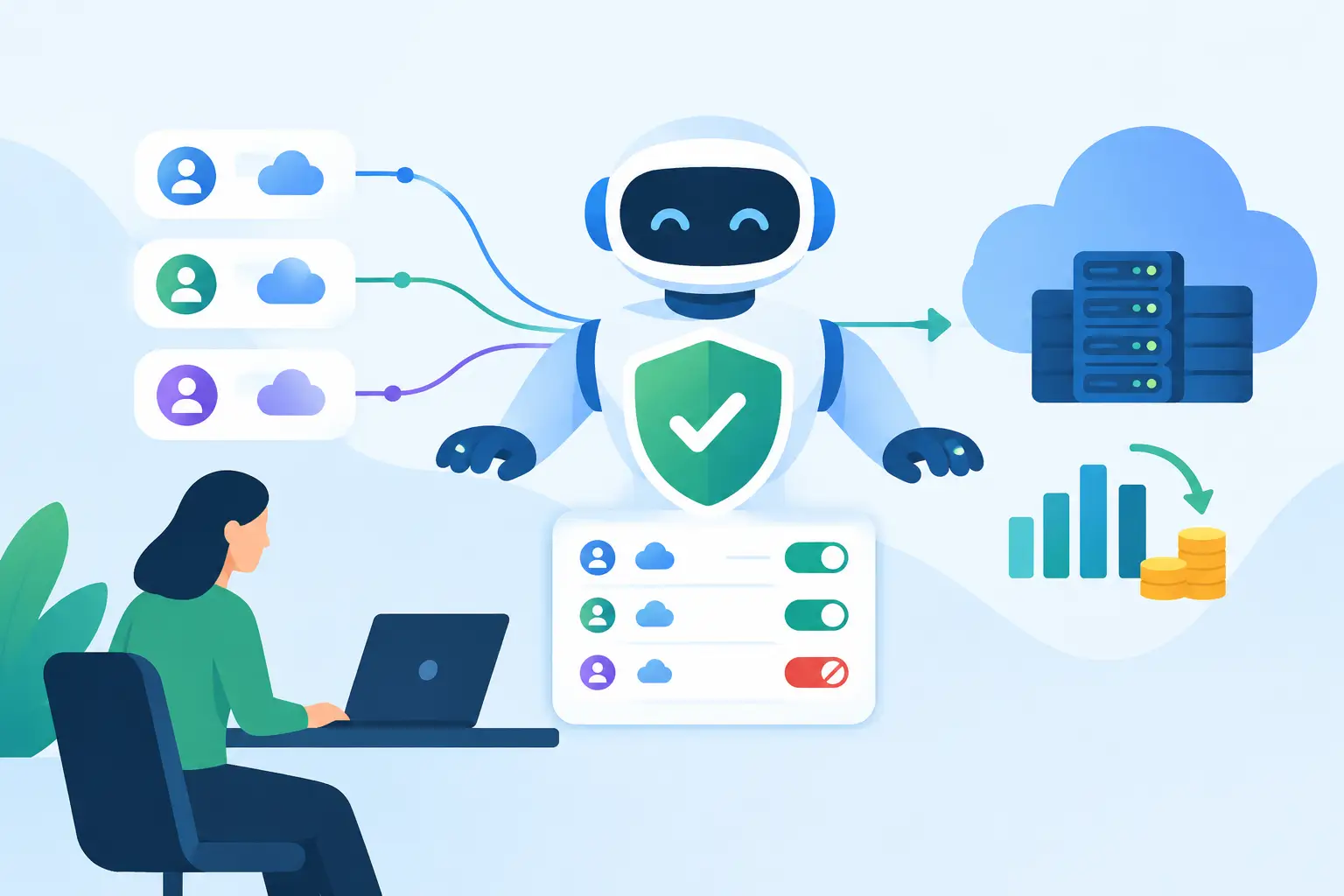
AI FinOps will increasingly operate where spend is created: between an application and its model providers. This is not about inserting finance into product delivery. It is about giving engineering, security and FinOps a common control point that can apply agreed rules without changing business logic across every application.
Cost is no longer a provider-level decision
A single provider account is simple to administer, but it is a poor operating model for varied production workloads. A customer-facing drafting task, an internal classification job and a high-stakes compliance workflow do not require the same model capability, latency profile or cost envelope. Sending all of them to one premium model may be easy, but it embeds an expensive default into every request.
The more mature approach is to define the capability required for each workload, then route to the most cost-effective suitable model according to explicit rules and priorities. This creates a useful tension: lower cost is not automatically better if quality falls below an acceptable level, and the highest capability is not automatically better if a smaller model produces the required result. AI FinOps needs to preserve that judgement rather than flatten it into a single rate card.
Unit economics need technical context
Cost per million tokens is useful for procurement. It is insufficient for operating a product. Teams need to understand which application, route, model decision and request pattern drove spend. They also need to distinguish productive usage from avoidable usage, such as oversized prompts, unnecessary retries or workflows that generate output no user consumes.
Per-request traces make this possible. They provide the operational evidence to investigate cost alongside latency, provider selection and policy outcomes. Metadata-only logging should be the default for this work, because visibility does not require retaining sensitive prompt and response payloads. Where payload retention is genuinely needed for a defined purpose, it should be an explicit opt-in with appropriate controls.
Governance and cost are the same operating problem
The old division between a security gateway and a cost dashboard will not hold for production AI. A request containing personal data, a request that breaches a spend cap and a request sent to an unsuitable provider are all control failures at the same boundary. Treating them as separate systems creates gaps, duplicate integrations and slow incident response.
A governed AI control plane applies a predictable sequence before a request reaches a provider: prompt shield, DLP, routing, then output moderation. This order matters. Prompt-injection and jailbreak shielding should be assessed before data handling. DLP can then log, warn, redact sensitive values as [REDACTED], or block the request according to policy. Only then should routing select the appropriate provider and model, with output moderation applied before the result returns to the application.
What a controlled AI FinOps model looks like
The strongest programmes do not begin with a dashboard project. They establish a small number of operational controls that make spend accountable without making development slow.
Routes turn model choice into a managed decision
Named routes give teams a stable contract while keeping provider and model choices centralised. An application can target auto or a logical route name rather than hard-coding a commercial decision into each service. Platform teams can then evolve routing rules and priorities as pricing, availability and model capability change.
This is particularly valuable when organisations support several products or business units. Product teams retain delivery speed, while the central team can set guardrails that reflect approved providers, workload requirements and resilience needs. Automatic failover protects availability when a provider has an issue, but it must still follow the defined route and policy posture rather than becoming an untracked exception.
Budget controls must be unambiguous
Budgets are useful only when their enforcement behaviour is clear. A hard spend cap should not quietly alter model quality or reroute traffic in ways that teams cannot explain. It should alert or block further requests, returning a 429 when the cap is reached. That makes the decision visible to the service owner and prevents a budget control from becoming an undisclosed product change.
The right cap depends on the workload. A development environment may need a modest limit that stops experimentation becoming an open-ended bill. A revenue-generating workflow may need a larger, carefully monitored allowance and an agreed response when it is exhausted. The point is not to use the same number everywhere. It is to ensure every limit has an owner, a purpose and a known effect.
Identity and evidence make allocation credible
Scoped API keys create practical accountability. They allow access to be limited by team, environment or use case rather than shared through a broad provider credential. Combined with traces and audit trails, this gives FinOps stakeholders evidence that can be reconciled with engineering activity without exposing customer content by default.
For regulated organisations, the value extends beyond allocation. Evidence of routing decisions, policy actions and access boundaries supports internal assurance and EU AI Act record-keeping. EU data residency and GDPR processor terms matter here, but they are not a substitute for disciplined retention choices and clear ownership of AI workflows.
The implementation test: control without a migration programme
AI FinOps will stall if every application needs a rewrite. The practical standard is much higher: existing applications should keep their OpenAI-compatible client behaviour, with the integration reduced to an API key and base-URL change. Business logic stays byte-for-byte identical while the request begins passing through one governed doorway.
That changes the adoption sequence. A platform team can start with a defined route and a non-critical workload, observe request traces, validate quality and establish a baseline for cost. It can then apply DLP actions, output moderation and hard caps where the operational case is clear. As confidence grows, more applications can move behind the same control point without each team building provider-specific middleware.
routeur.ai is designed around this model: routing, request-level policy enforcement, spend controls and audit evidence sit behind an OpenAI-compatible gateway. The objective is not to centralise every product decision. It is to centralise the controls that should not vary accidentally from one application to another.
The measure that matters is controlled efficiency
Average savings are valuable, but they are not the full definition of success. An apparently cheap AI estate is fragile if it cannot show why a request went to a given provider, whether sensitive data was redacted, or what happens when a team reaches its allocation. Equally, a perfectly governed platform that forces developers through lengthy approval queues will be bypassed.
The durable measure is controlled efficiency: the ability to deliver the required quality and availability at a known cost, with evidence that policies were applied on every request. It combines commercial discipline with engineering freedom.
The next useful question for an AI platform team is not, "Which model is cheapest this quarter?" It is, "Can we explain and control every production request that creates spend?" When the answer is yes, FinOps stops being a monthly reconciliation exercise and becomes part of the system that keeps AI products safe to scale.